IEEE Robotics and Automation Letters (RA-L)

Development of Adaptive-Limb Transformable Robot for Portable and Replaceable End-Effectors with Compact Lock-Spin Mechanisms

Jin Hirai Takuma Hiraoka Masanori Konishi Hiromi Tada Kunio Kojima Kei Okada

JSK Robotics Laboratory,
Graduate School of Information Science and Technology,
The University of Tokyo, Japan

Accepted in RA-L on October 23, 2025 · DOI: 10.1109/LRA.2025.3634910

Adaptive-limb transformable robot with multiple end-effectors
The proposed robot can operate in both wheeled and walking locomotion modes, and can perform manipulation tasks using a hook and wire-winding pulleys.

Abstract

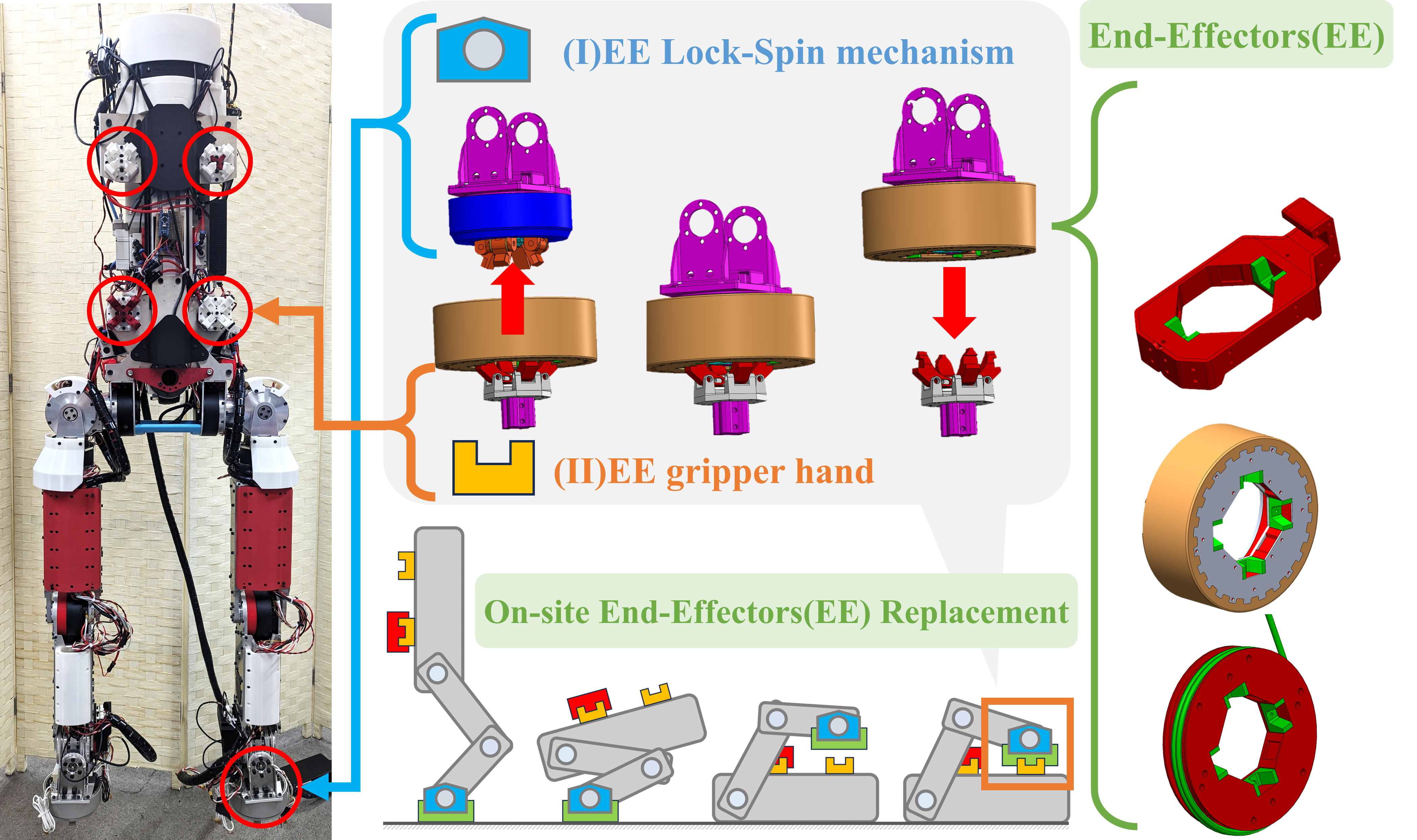
Transformable robots adapt to various environments by changing their shape or functionality. The robots are able to further expand their task range by replacing their end-effectors (EEs). In this paper, we propose an adaptive-limb transformable robot capable of replacing multiple types of mounted EEs. First, 7 degrees of freedom (DoF) limbs can reach multiple types of EEs mounted on the front body surface, and replace them using that single limb without relying on external devices. Second, we develop a compact Lock-Spin mechanism that integrates a locking mechanism into the rotor of the motor to enable continuous rotation. Experimental results demonstrate that the proposed transformable robot can replace EEs on-site and that this replacement enables locomotion and manipulation adapted to the environment.

Robot & Mechanism

Adaptive-Limb Transformable Robot

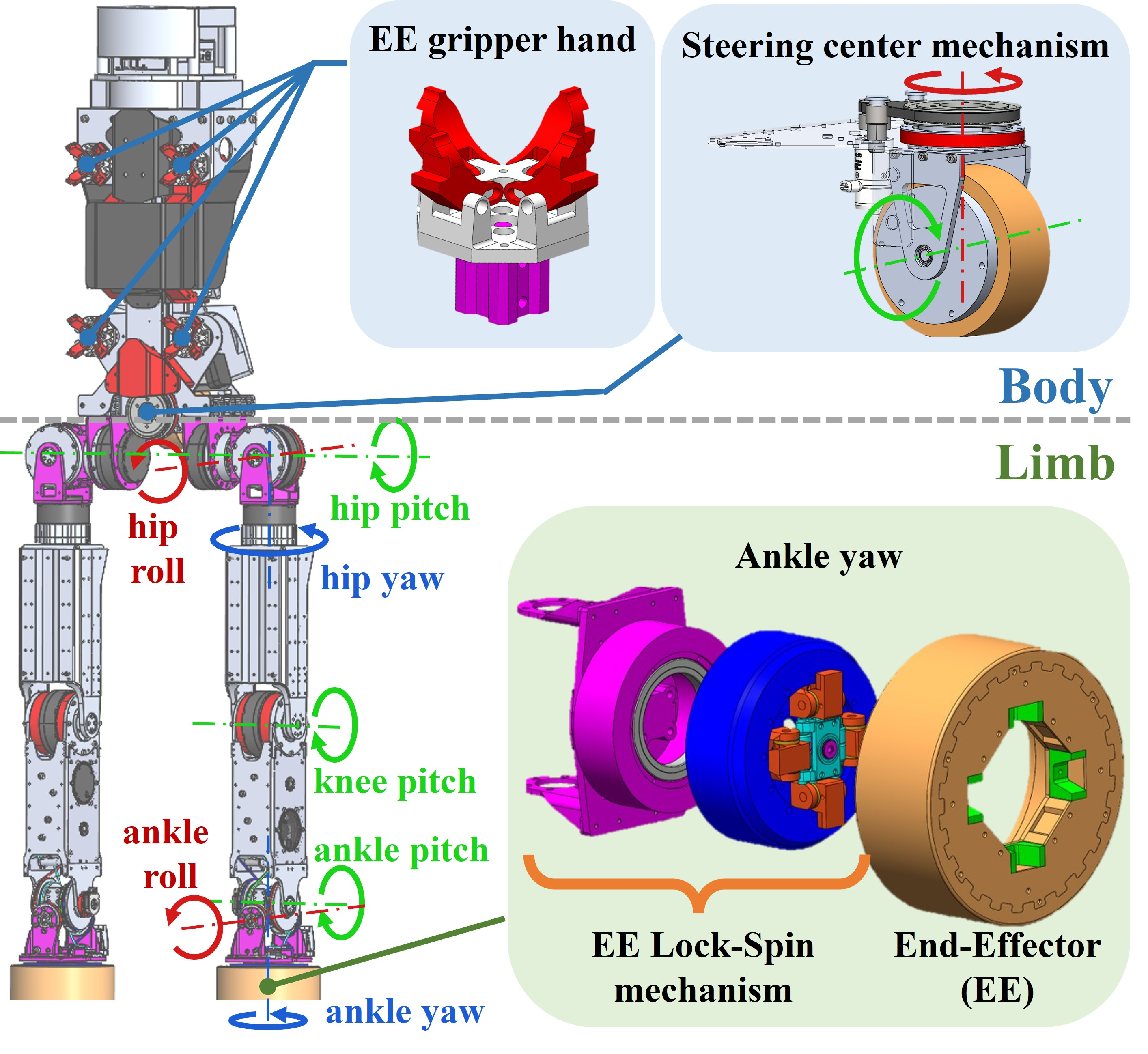
The proposed transformable robot consists of two main components.

  • Portability : a body structure equipped with multiple EE gripper hands to carry multiple types of mounted EEs.
  • Replaceability : a limb structure with 7-DoF and a wide range of motion to enable EE replacement.
EE Lock-Spin mechanism cross section

End-Effector (EE) Lock-Spin Mechanism

We developed the EE replacement mechanism to transmit rotational torque through the locking mechanism, which saves space.

  • Saving Space by Integrating Air Cylinder into Motor : integrating an air cylinder (replacement actuator) inside the motor (drive actuator) enables a compact structure.
  • Transmission of Rotational Torque by Lock Nail :The locking mechanism converts the linear motion of the air cylinder into rotational motion.
  • Rotation by Wedge with Centering Capability :The Wedge can transmit a stable force regardless of the contact position with the Lock Nail.

Experiments

Robustness Evaluation of EE Lock-Spin Mechanism in the Rotational Direction

To examine differences across multiple types of EEs, we used a wheel (diameter 150mm), a hook (top-view length 72mm × width 145mm), and a wire-winding pulley (diameter 120mm). Replacement success or failure was determined by whether the tapers of the EE Universal Socket of the EE and the EE Lock Nail engage with each other.
The average distance from the center of the EE Lock-Spin mechanism to the EE's outer perimeter is larger for the wheel than the hook and the wire-winding pulley, so the outer edge lies farther from the Lock Nail-EE Universal Socket engagement point. An appropriate combination of EE geometry and taper angle enables a balanced design for the target task.

Experiment on EE Replacement

To verify the effectiveness of the reachability evaluation, we perform experiments that the robot can replace multiple types of mounted EEs.

Experiment on EE Detachment Using the Upper Body EE Gripper Hand

We verify that the EE mounted on the EE Lock-Spin mechanism can be detached using the EE gripper hand.

Experiment on EE Attachment Using the Lower Body EE Gripper Hand

We verify that the EE can be attached to the EE Lock-Spin mechanism using the EE gripper hand.

Multi-Mode Experiments Using Wheels and Hook

The proposed transformable robot performs multi-mode experiments using wheels and a hook.

Forward Motion Using Wheels.

The robot is supported at three contact points: one 107mm-diameter wheel attached to the steering center joint, and two 150mm-diameter wheels mounted on the EE Lock-Spin mechanism. Each wheel tracks its target under position control. The robot moves straight for 0.6m.

EE Replacement.

The EE is replaced between the EE Lock-Spin mechanism located on the distal limb and the EE gripper hands mounted on the upper and lower sections of the body. After detaching the wheel from the EE Lock-Spin mechanism, the robot rotates the hip yaw joint by 180 deg while avoiding interference and then attaches the hook.

Drawer Opening and Closing Using a Hook

The EE is replaced between the EE Lock-Spin mechanism located on the distal limb and the EE gripper hands mounted on the upper and lower sections of the body. After detaching the wheel from the EE Lock-Spin mechanism, the robot rotates the hip yaw joint by 180 deg while avoiding interference and then attaches the hook.

BibTeX

Feel free to cite this paper as follows:

@article{hirai:ral2025eetransform,
  author={J. Hirai and T. Hiraoka and M. Konishi and H. Tada and K. Kojima and K. Okada},
  title={{Development of Adaptive-Limb Transformable Robot for Portable and Replaceable End-Effectors With Compact Lock-Spin Mechanisms}},
  journal={IEEE Robotics and Automation Letters}, 
  year={2026},
  volume={11},
  number={1},
  pages={858-865},
  note={presented at ICRA2026}
  doi={10.1109/LRA.2025.3634910}}

Contact

If you have questions, please contact Jin Hirai .